Roll forming
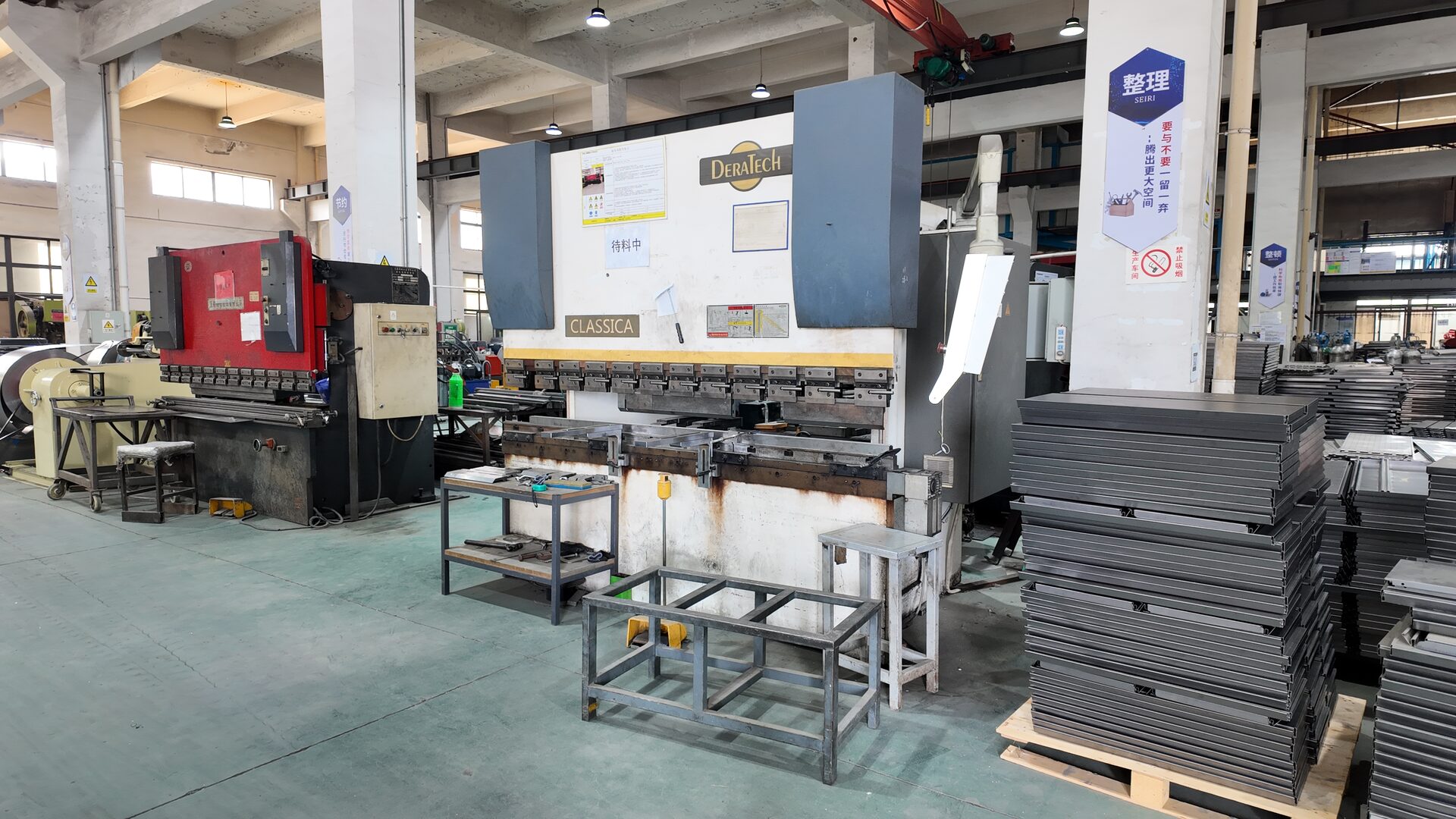
16+ roll-forming lines produce continuous formed profiles from coil, which is the basis for repeated components in a custom project.
CMJ RACKS combines multiple metal-processing capabilities under one manufacturing system, covering forming, punching, welding, laser cutting and powder coating for custom metal product projects. This page sets out the equipment behind that capacity, how the production resources are deployed, and how they support custom work.
Metal processing at CMJ RACKS runs on 16+ roll-forming lines, 20 punching and CNC press machines, 6 robotic welding units, 4 laser cutting machines and 3 automated powder coating lines, with the longest coating line running 860 m. These are the production resources behind custom metal product work: forming, punching, welding, cutting and finishing are all carried out in house, so a project can move between processes within the same manufacturing system instead of being split across suppliers.
Production resources
Each production resource below is described at the capacity level: what the equipment contributes to a project. How each process works is covered on its own page under Manufacturing.
16+ roll-forming lines produce continuous formed profiles from coil, which is the basis for repeated components in a custom project.
20 punching and CNC press machines handle hole patterns, cut-outs and formed features across components.
6 robotic welding units carry out repeatable welded joints, which supports consistent output on repeated components.
4 laser cutting machines cut sheet and plate to drawing, giving the flexibility needed when a project mixes component types.
3 automated powder coating lines apply surface finish in house, and the longest line runs 860 m.
Because these resources sit in one manufacturing system, components can move between forming, punching, welding, cutting and finishing without leaving the factory.
Process coverage
At the capacity level, a custom job moves through the following stages. This is the routing only; the technical detail of each stage belongs to the Manufacturing pages.
Capacity at CMJ RACKS is best understood as coverage rather than as a single output figure. The equipment set covers the main metalworking stages, which means a custom project can be produced in house from formed profiles through to a finished coated component.
That coverage is what makes mixed component requirements practical. A project that needs formed profiles, punched features, welded assemblies and cut sheet in the same order can have those produced within one manufacturing system, rather than being coordinated across separate suppliers and transport steps.
Repeated production benefits from the same arrangement. The roll-forming lines, robotic welding units and automated coating lines are suited to producing the same component consistently across a run, while the punching and laser cutting capacity provides the flexibility for the variations a project requires.
This page describes what the capacity covers and how it is deployed. The working detail of each process is covered under Manufacturing.
Custom projects
The production resources are used across standard production, custom work and projects that mix both.
Repeated components and regular production runs use the roll-forming, robotic welding and automated coating capacity.
Beside the standard lines, the punching and laser cutting equipment handles components made to project drawings.
Because the processes sit in one system, a project can combine repeated components with one-off parts in the same production.
Commercial and retail fixture work draws on the same capacity, from formed profile components through to finished coated parts.
Custom metal product work and custom manufacturing services are covered on their own pages; this page stays at the capacity level.
Scale context
The equipment set operates within a manufacturing base of the following scale. This is context for the capacity described above; the factory itself is covered on the factory pages.
The production resources are housed on a 29,800+ m² manufacturing base.
Production, engineering and support functions are staffed by 200+ employees.
The manufacturing operation draws on 30+ years of manufacturing experience.
Components and products produced on this capacity are exported to 80+ countries.
Transparency
Equipment coverage and production capacity are not the same as a guaranteed output figure. The numbers on this page describe the equipment available; they should not be read as a fixed monthly or annual output, and no such figure is published here.
Actual production capacity depends on the project in question.
How much capacity a given project uses depends on several factors: the product design, the material specification, the processing requirements, the production mix at the time, and how the order is configured. Two projects that both run through the same equipment can therefore place very different demands on it.
For that reason this page does not state a fixed monthly or annual production output. What it states is what the factory is equipped with — the lines, machines and units listed above — and how those resources are used to produce custom metal components.
If you need to understand what is achievable for a specific project, the practical route is to send the drawings and requirements, and the factory will respond against the actual configuration.
Related pages
This page covers production capacity. Each related topic below has its own page, and the detail lives there.
The factory cluster hub: scale, manufacturing capability, production flow and routing.
Go to Factory ›Factory infrastructure, the manufacturing environment and how production areas are organized.
Go to Factory Overview ›Quality systems and the certification evidence held by the manufacturing entity.
Go to Quality & Certifications ›How products are made: the manufacturing hub for engineering, production flow and quality control.
Go to Manufacturing ›The roll forming process behind the formed profile components.
Go to Roll Forming ›The punching and CNC pressing process for holes, cut-outs and features.
Go to Punching ›The robotic welding process for repeatable welded joints.
Go to Robotic Welding ›The laser cutting process for sheet and plate cut to drawing.
Go to Laser Cutting ›The powder coating process applied on the automated coating lines.
Go to Powder Coating ›What the factory can produce from this capacity for custom metal product projects.
Go to Custom Metal Products ›OEM and ODM projects built to drawings, samples and requirements.
Go to Custom Manufacturing ›Send drawings, samples or requirements and receive a quotation.
Go to Contact ›Questions
CMJ RACKS products are manufactured by Suzhou Chuangmeijia Metal Products Manufacturing Co., Ltd. at No. 160 Liantang Avenue, Shanghu Town, Changshu City, Suzhou, Jiangsu Province, China. Send your drawings, samples or requirements and we will respond with a quotation.