
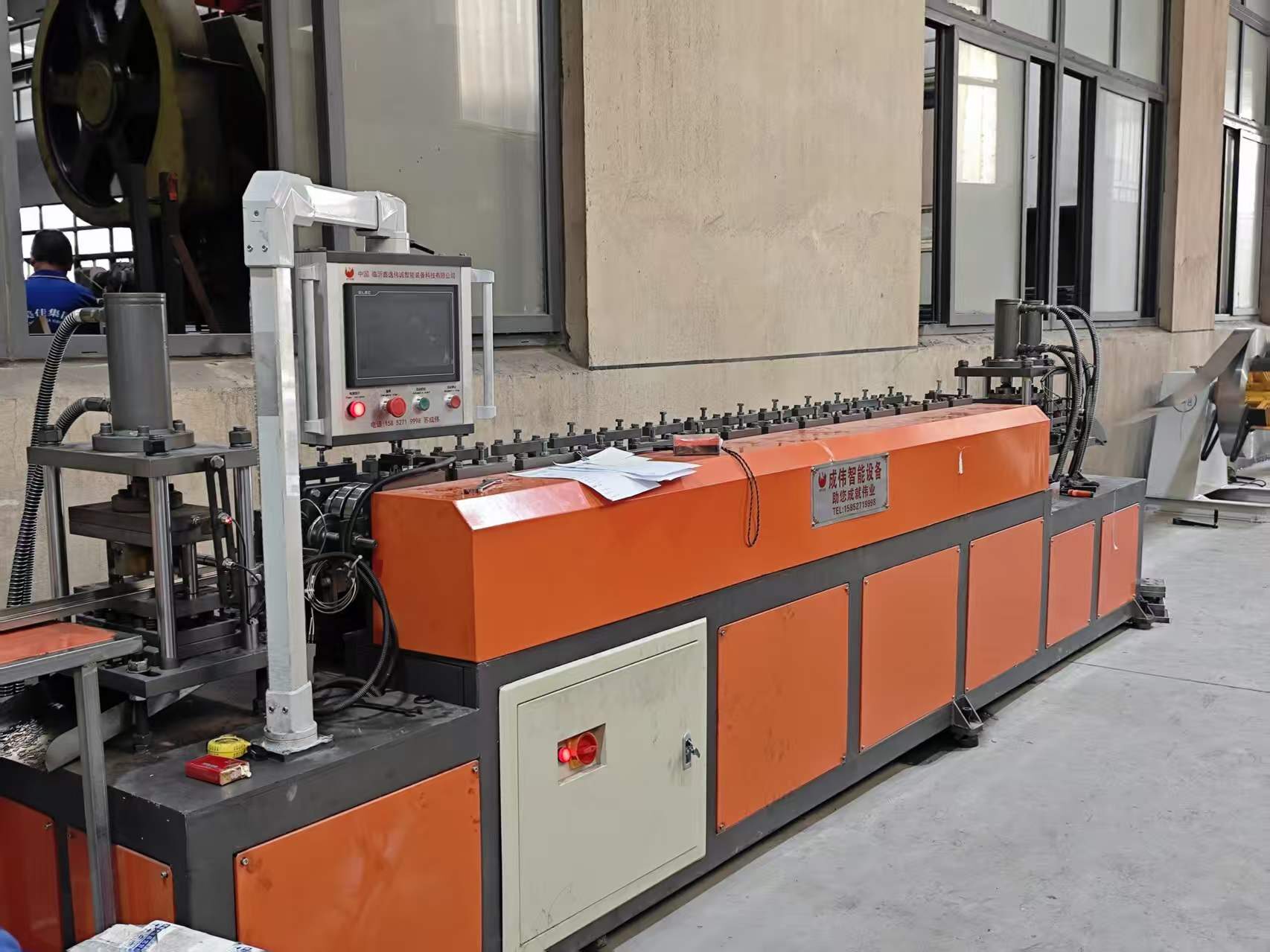
Coil enters
The coil is unrolled and fed into the forming line as a continuous strip, so the process works on material that is always moving rather than on discrete parts loaded one at a time.
CMJ RACKS uses roll forming to turn steel coil into continuous metal profiles. The coil is fed through a set of rolls, and each roll set changes the material a little further, so the required section is built up gradually rather than shaped in one action. The profile leaves the process as a continuous length with a uniform cross-section — the profile geometry a component is built around.
Roll forming is the continuous forming stage in the CMJ RACKS manufacturing sequence. Steel coil is fed through a set of rolls; each roll set changes the material a little further, so the section develops gradually instead of being shaped in one action. The process produces a continuous profile with a uniform cross-section along its length, and that profile is the profile geometry a component is built around. CMJ RACKS uses this stage for formed components across racks, shelving, retail fixtures and other custom metal products, where a design calls for a repeated, consistent section rather than a one-off shape. The equipment behind the process and the manufacturing system around it are covered on their own pages.
Capability
Roll forming at CMJ RACKS is a production stage for components that need the same cross-section along their length, and that are needed repeatedly. It is not a one-off shaping process.
The input is steel coil, fed into the forming line as a continuous strip. The output is a continuous profile carrying a uniform section from end to end. Between those two points the material is shaped progressively, in sequence, while it keeps moving.
That shape of process suits a particular kind of part. If a component repeats the same section along its length, and that component is required across a production run rather than once, roll forming is the stage that produces it. The formed profile then provides the profile geometry that the rest of the component is built around.
CMJ RACKS runs this stage as part of an in-house manufacturing sequence, so the formed profile does not leave the factory before the stages that follow have been applied to it.
The forming logic
The section is not produced in a single action. It develops as the material travels, which is the basis of the whole process.
The coil is unrolled and fed into the forming line as a continuous strip, so the process works on material that is always moving rather than on discrete parts loaded one at a time.
As the strip travels, the rolls along the line each change it a small amount. The forming work is spread across the sequence instead of being concentrated at one point.
Because each roll set takes the material a little further, the cross-section develops as the strip advances, reaching its finished shape only at the end of the sequence.
What leaves the process is one continuous profile with a constant section along its length, which is then cut to the lengths a component requires.
Roll forming changes the material gradually, in small increments, rather than forcing it into its final shape at once. Working the strip that way is what allows the same cross-section to be produced along the whole run. This page covers that logic; the equipment and capacity behind it are covered on the production capacity page.
Applications
Roll forming carries components that share a uniform section, are required repeatedly, and can be cut from a continuous run.
Parts that hold the same cross-section from one end to the other, with no change of shape along their length.
Parts used across a product range or repeated within a single product, where the same section is called for more than once.
Parts of different lengths taken from the same continuous profile rather than produced as separate pieces.
Typical formed components
These are the component types this stage carries, not a product catalogue. The product families themselves are covered on the product pages.
In the process
This section covers only the stages immediately either side of roll forming. The manufacturing workflow as a whole is covered on the Manufacturing hub.
Because the profile leaves the forming stage as a continuous length, the stages that follow work on material that already has its section. What those stages do depends on the component.
In practice that can mean punching, welding or powder coating, depending on what the part needs. Roll forming produces the profile; the processing applied to it belongs to the stages that follow, and each of those has its own page.
Questions
Roll forming is one stage of the manufacturing sequence. The stage pages below cover the processes that work on a formed profile, and the Manufacturing hub covers how the stages connect as one system.