
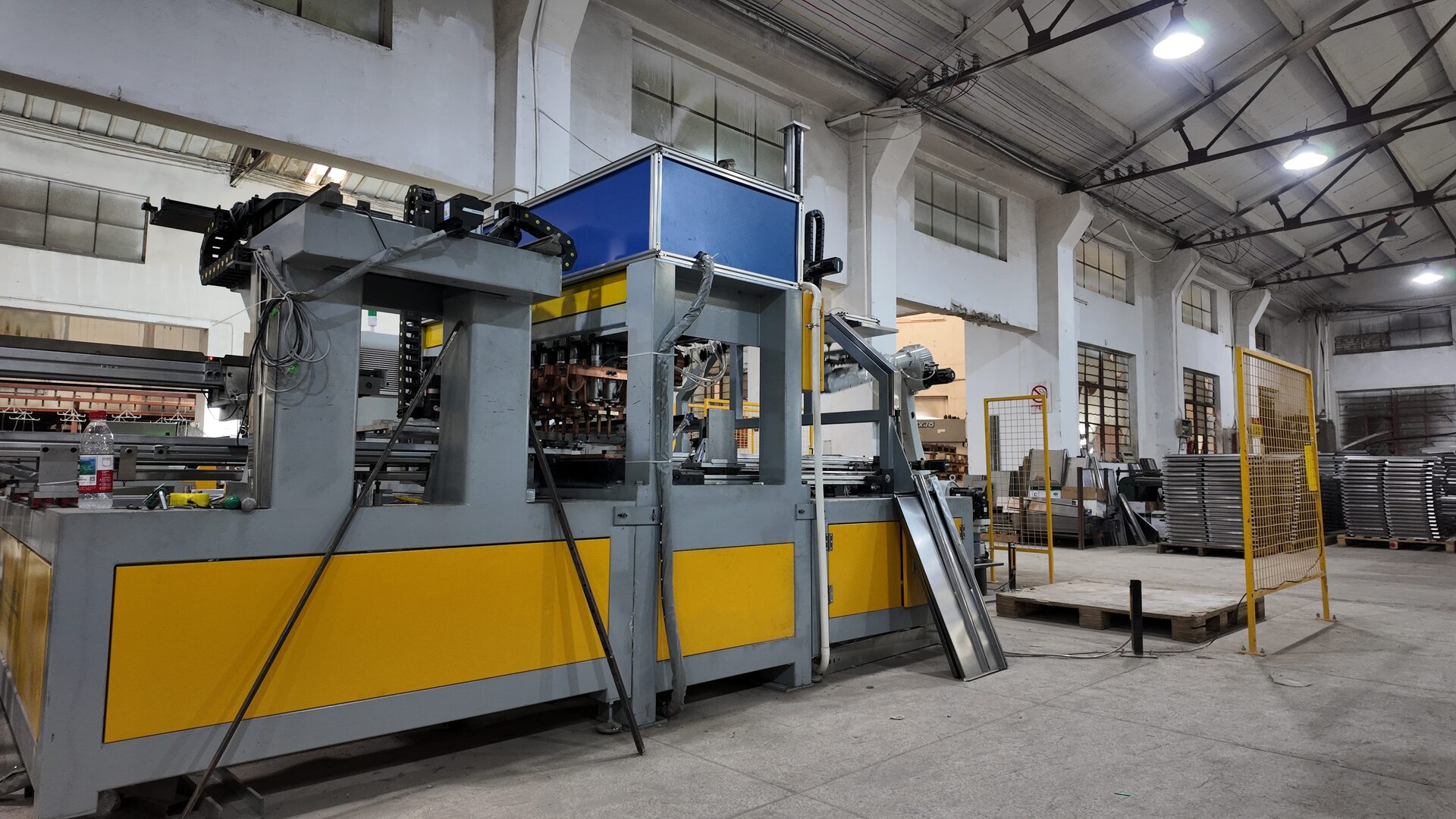
A set, not a single part
A welded component is made of several parts. Each of them was produced on its own, and each of them is complete before the stage begins.
Robotic welding is the stage at CMJ RACKS where separate metal parts stop being separate. The parts arrive already carrying the shape they were formed with and the features punched into them, and this stage positions them and joins them into a single assembly. Because the joining is carried out under machine control, an assembly that is built more than once is joined the same way each time.
Robotic welding is the joining stage of the CMJ RACKS manufacturing sequence. Parts that have already been formed and punched are brought together, positioned in the arrangement the component calls for, and joined into one assembly under machine control. The stage does not shape the material and does not open the material — it connects parts that already exist, so its output is an assembly rather than a further-processed single part. From there the welded assembly goes on to whichever processing the component still requires. The equipment behind the process and the manufacturing system around it are covered on their own pages.
The joining logic
Forming gives a part its shape. Punching gives a part its features. Welding does neither — it is the stage that makes one part hold on to another.
By the time a component reaches this stage, its single parts are already finished. Each one carries the shape it was formed with and the features that were punched into it. Welding works with those parts exactly as they arrive.
That is what separates this stage from the two before it. Forming establishes a section, punching introduces features — both of them change a single part. Welding neither establishes nor introduces. It takes parts that are complete on their own and makes them behave as one object.
The consequence is that a welded component is defined by its arrangement. Its strength and its shape come from how the individual parts sit relative to each other, and from the fact that this arrangement is then fixed. A welded assembly is not one part that was processed further; it is several parts held together.
Assembly formation
A welded component is built from a set of parts, and what holds the set together is where each part is placed before it is joined.
A welded component is made of several parts. Each of them was produced on its own, and each of them is complete before the stage begins.
Before anything is joined, the parts are positioned relative to one another in the arrangement the design calls for. Where a part sits decides what the finished component is.
The joining action is what freezes the arrangement the parts were placed in, so the assembly holds its shape instead of relying on the parts staying put on their own.
What leaves the stage is not a part with something added to it, but an assembly whose shape comes from how its parts are held together.
Two assemblies can be built from the same set of parts and still be different components, because what differs is how the parts are positioned before they are joined. That is why this stage is about bringing parts into relation with each other rather than about processing any one part on its own.
The automated element
The same assembly is generally built more than once. What a robotic stage contributes is that the joining action and its placement are set by the process rather than judged fresh at every joint.
Where a component is built across a production run, the same arrangement of parts is brought together again and again. Each one has to end up joined the same way as the one before it.
The joining is carried out by the machine rather than re-decided by hand at each joint, so where the join lands is a property of the process rather than of the moment.
Because the action and its placement are controlled, an assembly that is built again is joined the same way. This is what the word robotic refers to at CMJ RACKS.
This is a description of what the stage does, not a claim about a measured result. Figures for equipment and output belong to the production capacity page.
Where it is used
Welding suits components that are assembled from more than one part rather than produced in a single piece.
Components whose shape comes from how several parts are arranged, such as the frame structures behind racks and shelving.
Display and fixture assemblies built up from more than one part, where the finished unit has to hold its shape as a single structure.
Built-to-requirement components where a set of formed and punched parts has to be brought together as one assembly.
What these components have in common
These are the properties that make a component suited to the stage, not a specification of what can be joined. The product families that use them are covered on the product pages.
In the process
This section covers only the stages immediately either side of welding. The manufacturing workflow as a whole is covered on the Manufacturing hub.
Because the parts arrive already formed and already featured, what welding adds is the connection between them. The stages before this one produce the individual parts; this stage is where those parts become one object.
In practice that can mean applying the finish to the welded assembly last, or cutting further material alongside it, depending on what the component needs. Welding makes the connection; the processing applied around it belongs to the stages either side, and each of those has its own page.
Questions
Welding is one stage of the manufacturing sequence, and it is the stage that depends on the ones before it. The pages below cover the stages that produce the parts this one joins, and the Manufacturing hub that covers how the stages connect as one system.